

Prepared and funded by Ethypharm. UK-NONP-65. Date of preparation: April 2026.
- drug deaths in england and wales reach highest levels ever
recorded(i) - deaths involving drugs adulterated with nitazenes increase by 400% in a single year(ii)
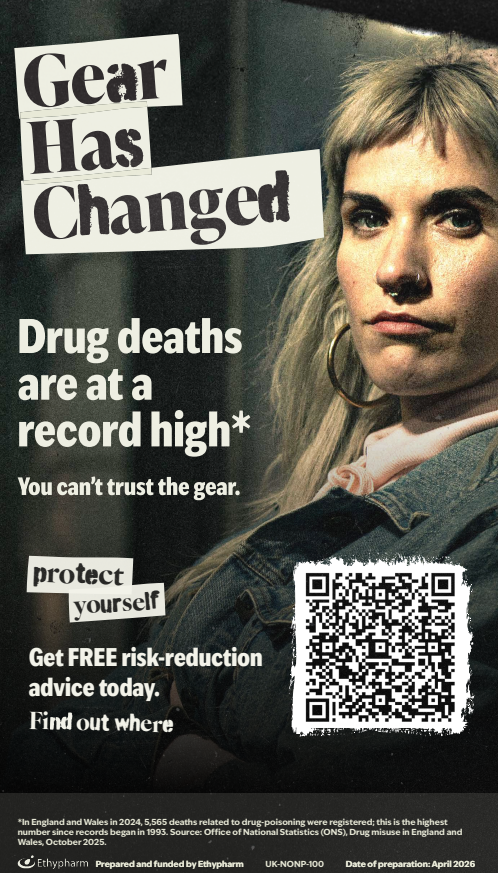
‘Gear Has Changed’, an unapologetically hard-hitting public health campaign launching in April 2026, aims to protect drug users from accidental overdose caused by street drugs adulterated with lethal illicit substances such as nitazenes.
The UK drug supply has fundamentally changed over recent years with the introduction of high-potency opioids, including nitazenes – which are capable of causing fatal overdose at very low doses.(iii,iv)
Outdoor advertising will target active drug users, new and experienced, and their friends and families in Birmingham, Portsmouth, Middlesbrough, Glasgow and Blackpool - the five UK cities with the highest drug-related deaths per capita.
By posting hard-hitting harm-reduction messages directly into city centres, ‘Gear Has Changed’ aims to disrupt assumptions, raise awareness and signpost people in active substance dependency, and their circle of care, towards support.
Peter Furlong, Harm Reduction Lead Change Grow Live (CGL) commented, “People who use recreational drugs can no longer assume they know what they’re taking or how strong it is. Highly adulterated substances are appearing in recreational drugs sold as something else entirely, significantly increasing the risk of accidental overdose.”
“Nitazenes can be up to 500 times stronger than heroin and can suppress the respiratory system. (v,vi) This overdose risk is as severe amongst new, less experienced users, as it is amongst the more experienced who believe they are taking a familiar substance at a familiar dose, possibly from a dealer they believe they can trust.”
The impact is severe. In 2024, deaths involving nitazenes increased by almost 400% in a single year, from 52 in 2023 to 195 in 2024.(ii) More broadly, drugpoisoning deaths in England and Wales reached their highest level ever recorded, while Scotland has reported some of the highest drug-related death rates in Europe.(ii,vii)
Despite this increase, researchers still warn that drug-related deaths may be significantly underreported. Analysis of UK National Programme on Substance Use Mortality (NPSUM) data identified a 33% excess in drug deaths in Birmingham and Solihull, suggesting some nitazene cases may be going undetected.(viii)
The Gear Has Changed campaign directs those at risk, and their wider circle of care, to engage with services that provide support, spanning pharmacies, healthcare professionals and drug and alcohol services, who can:
- Reinforce messages about the increasing unpredictability of the illicit drug supply
- Encourage early contact with local drug and alcohol services among people who use drugs (new and experienced), as well as their friends, families, and wider support networks.
- Provide impartial, non-judgemental advice and support that reduces stigma
Prepared and funded by Ethypharm. UK-NONP-65. Date of preparation: April 2026.
References:
(i) Office for National Statistics. (2025). Deaths related to drug poisoning in England and Wales: 2024 registrations. Office for National Statistics.
(ii) Office for National Statistics. (2025). Deaths related to drug poisoning in England and Wales: 2024 registrations. Office for National Statistics.
(iii) National Crime Agency (2025) NSA 2025 – Drugs.
(iv) Royal Borough of Greenwich (2025) Synthetic Opioids Bulletin – March 2025.
(v) Holland, A., Copeland, C.S. and Waring, G.W. (2024) ‘Nitazenes—heralding a second wave for the UK drug-related death crisis?’, The Lancet Public Health, 9(2), pp. e71–e72. doi:10.1016/S2468-2667(24)00001-X.
(vi) Wilkinson, E. (2024) ‘Everything you need to know about nitazenes’, The Pharmaceutical Journal, 8 February.
(vii) Public Health Scotland. (2024). Analysis reveals families and communities impacted by drug-related deaths in Scotland.
(viii) Chen, S. et al. (2026). Is nitazene-related mortality underestimated? Findings from an in vivo and ex vivo rat study and pharmacoepidemiological analysis of coroner-reported deaths. Clinical Toxicology.
Other News & Events